National and State Breakdown: Daycare Prices Per Week for Infants
Understanding how much childcare costs requires looking at regional benchmarks. Nationally, the average weekly cost for center-based infant care is roughly $310 per week, though broader infant care measures sit near $279 per week. These numbers provide a realistic baseline, but regional markets show dramatic spreads. Major metropolitan areas regularly see tuition climb beyond $600 weekly, while rural communities often feature lower baseline rates. For new parents, these figures are more than abstract statistics—they shape monthly budgets, influence return-to-work timelines, and determine whether families can afford the quality of care they want for their babies.
State-by-State Weekly Cost Variations
Daycare tuition reflects local labor markets, real estate costs, and state licensing mandates. A comparison of state medians highlights these wide geographical differences. In high-cost urban corridors, weekly rates can consume a significant share of a household’s take-home pay, while lower-cost states offer some breathing room. Parents who are relocating, comparing job offers, or simply planning ahead should treat these state-level figures as a starting point rather than a final quote, since individual centers within the same state may charge more or less based on neighborhood demand, facility amenities, and staff qualifications.
| State / Region | Median Weekly Infant Rate (Center-Based) | Estimated Annual Cost |
|---|---|---|
| District of Columbia | $490.00 | $25,480 |
| Massachusetts | $461.55 | $24,000 |
| Colorado Springs, CO | $260.00 – $340.00 | $13,520 – $17,680 |
| Texas | $185.00 | $9,620 |
| Arkansas | $140.00 | $7,280 |
| Mississippi | $118.68 | $6,171 |
At Humbled Hearts, tuition for ages 4 weeks–1 year is $400/week full-time or $300/week part-time. For ages 2–3 years, tuition is $380/week full-time or $290/week part-time.
According to federal childcare price data across all 50 states, high-cost jurisdictions like Washington, D.C. and Massachusetts command more than triple the median weekly rates found in states like Mississippi and Arkansas. In mid-tier markets and cities like Colorado Springs, parents frequently see full-time center tuition settle between $260 and $340 per week. These gaps are not random; they track closely with regional differences in minimum wage laws, commercial lease rates, and the availability of qualified early childhood educators. For families in Milwaukee and similar mid-sized metros, the practical takeaway is to research local centers early and ask for a detailed tuition sheet rather than relying on national or state averages alone.
Understanding Center-Based Infant Daycare Pricing
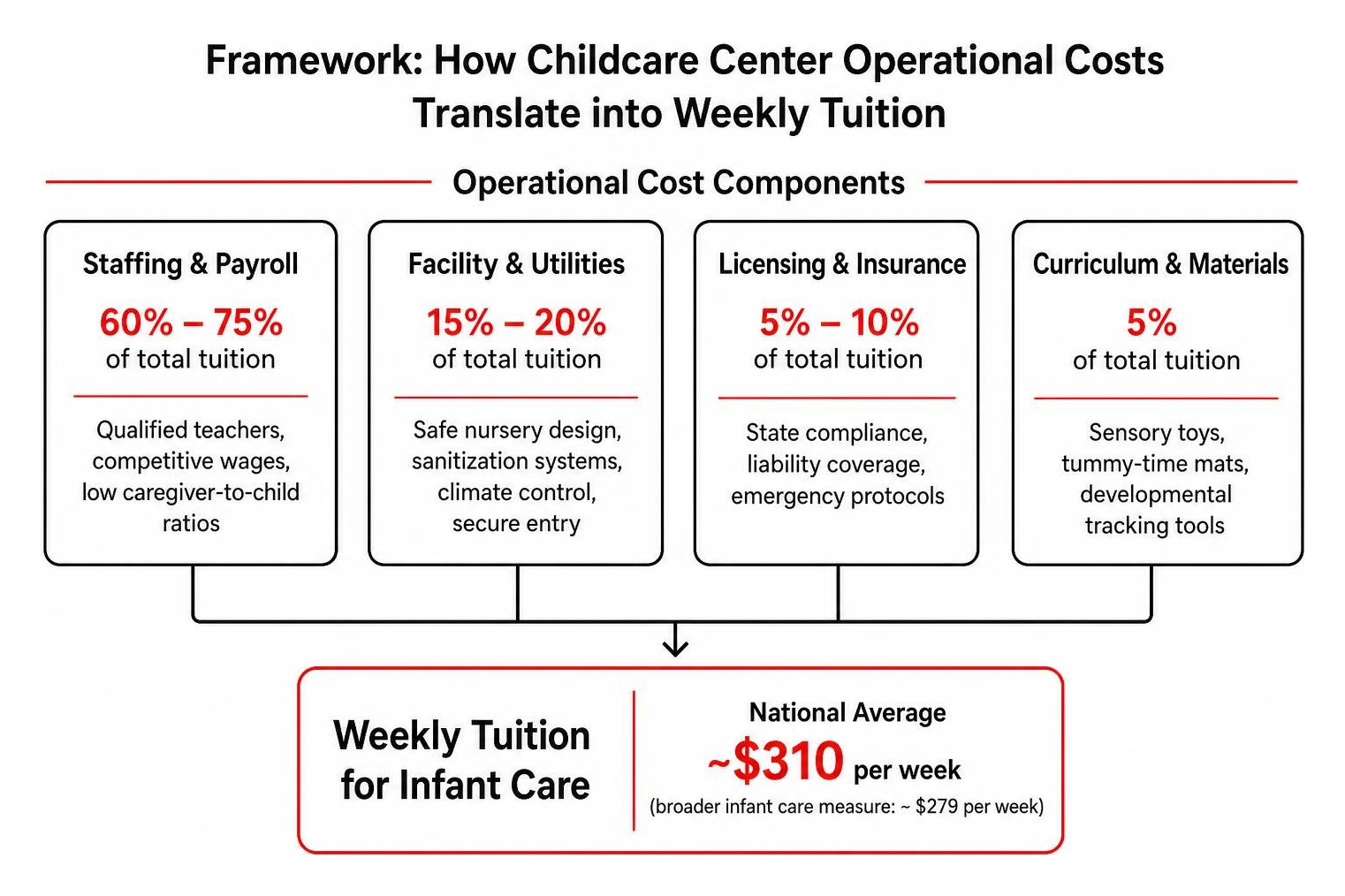
Center-based care involves clear standards for daily care, dedicated early education facilities, specialized infant equipment, and state licensing requirements. When evaluating daycare centers, your tuition helps pay for the staffing, facilities, and supplies needed to keep babies safe and engaged. Licensed centers must maintain consistent staffing, documented safety procedures, and age-appropriate learning environments—all of which contribute to the weekly rate. Understanding these components helps parents see what they are paying for and why infant care is priced differently from care for older children.
| Cost Component | What It Covers | Budget Impact |
|---|---|---|
| Staffing & Payroll | Qualified teachers, competitive wages, low caregiver-to-child ratios | 60% – 75% of total tuition |
| Facility & Utilities | Safe nursery design, sanitization systems, climate control, secure entry | 15% – 20% of total tuition |
| Licensing & Insurance | State compliance, liability coverage, emergency protocols | 5% – 10% of total tuition |
| Curriculum & Materials | Sensory toys, tummy-time mats, developmental tracking tools | 5% of total tuition |
These investments ensure comprehensive care, but they also explain why licensed centers carry structured rate sheets. For example, a center that invests in ongoing teacher training, low staff turnover, and specialized infant equipment may charge more per week, but that premium often translates into more consistent caregiving and a safer environment. Parents should ask prospective centers how tuition is allocated, what staff qualifications are required, and how often materials are replaced. Transparent centers are usually happy to walk families through these details during a tour or enrollment conversation.
Why Infant Childcare Costs More Than Older Age Groups
New parents are often surprised to discover that infant tuition is significantly higher than toddler or preschool care. Across the country, infant care costs roughly 30% to 42% more than preschool programs. The difference comes down to hands-on care requirements, feeding schedules, diapering, and legal oversight. For a family budgeting for the first year, this premium can feel overwhelming, but it reflects real operational constraints that centers must manage every day. Understanding these cost drivers can help parents make informed choices about full-time versus part-time care, program options, and the timing of transitions to less expensive age groups.
Key Factors Driving Daycare Prices Per Week for Infants
The primary driver behind infant childcare pricing is the legally mandated caregiver-to-child ratio. State licensing regulations generally require a 1:3 or 1:4 ratio for infants, compared to 1:8 or 1:10 for older preschool classrooms. This means a center serving twelve infants needs at least three or four dedicated caregivers, while the same number of preschoolers might require only one or two. Because one educator can only care for three or four babies at a time, staffing expenses represent the largest share of a center's operational budget. As outlined in comprehensive first-year infant care cost guides, labor makes up roughly 60% to 75% of operating expenses. When enrolling your baby in structured programs, lower child-to-teacher ratios ensure safety and nurturing engagement, directly influencing daycare prices per week for infants.
Beyond ratios, infant care demands more individualized attention throughout the day. Babies need to be held during feedings, changed frequently, soothed during naps, and monitored for developmental milestones. Caregivers must also follow strict sanitation protocols for bottles, pacifiers, and play surfaces. These tasks are time-intensive and cannot be rushed, which means centers must schedule enough staff to cover breaks, absences, and the unpredictable rhythms of infant care. In contrast, older children can participate in group activities, follow routines more independently, and require less one-on-one physical care. The result is a pricing structure that reflects the true cost of providing safe, responsive care for the youngest children.
Hidden and Additional Daycare Expenses to Expect
Tuition is not always the only line item on your weekly or monthly invoice. When building your family budget, keep these secondary expenses in mind:
- Registration and Enrollment Fees: Non-refundable administrative deposits charged annually or upon enrollment (ranging from $50 to $200). These fees often cover paperwork, background checks, and the administrative time required to set up a new family file.
- Consumable Supply Fees: Some facilities charge supply fees to cover daily wipes, sanitizing agents, or specialty linens. Ask whether these are included in tuition or billed separately, and whether the fee is charged per child or per family.
- Diapers, Formula, and Food: Many centers require parents to supply daily diapering essentials, formula or breast milk, and purees. Some centers include these items in tuition, but most do not, so parents should budget for an additional $50 to $100 per month depending on brand preferences and feeding needs.
- Late Pickup Penalties: Providers often charge per-minute fees (commonly $1 to $5 per minute or $15 to $25 per 15-minute window) if pickups occur after operating hours. These penalties are not meant to be punitive; they compensate staff who must stay beyond their scheduled shifts. To avoid them, build a buffer into your commute and have a backup pickup plan for unexpected delays.
Other potential costs include annual activity fees, holiday or inclement weather closures that still require tuition payment, and optional enrichment programs such as music or sign language classes. Reading the enrollment agreement carefully and asking for a written list of all possible charges can prevent surprises later. Many centers are willing to explain their fee structure in detail, and some offer payment plans or discounts for annual prepayment.
Strategic Budgeting Tips and Financial Assistance for Parents
Managing infant childcare costs requires early planning and taking advantage of available financial tools. The good news is that many families can reduce their out-of-pocket burden through tax strategies, employer benefits, and community programs. The key is to start early, keep good records, and ask questions about every possible discount or subsidy. Even small savings—such as a 5% sibling discount or a few hundred dollars in tax credits—can add up over the course of a year.
Tax Credits and Pre-Tax Savings Accounts
Tax credits and accounts that offer tax savings may help reduce your out-of-pocket childcare expenses:
- Dependent Care FSA (DCFSA): Offered through many employers, this account lets you set aside pre-tax dollars (up to standard federal limits, commonly $5,000) for qualified childcare expenses. This reduces your overall taxable income. Because contributions are deducted before taxes are calculated, families in higher tax brackets may save hundreds or even thousands of dollars annually. Check with your employer during open enrollment, as DCFSA participation typically must be elected in advance.
- Child and Dependent Care Tax Credit: When filing federal taxes, parents may claim a percentage of work-related childcare expenses, directly reducing their tax liability. The credit is based on your income and the amount you paid for care, and it can be claimed even if you also use a DCFSA, though the same expenses cannot be double-counted. Keep receipts and provider tax identification numbers organized throughout the year to make filing easier.
- Employer Subsidies: Ask your human resources department if your company offers childcare stipends, backup childcare coverage, or corporate rate arrangements. Some employers partner with local centers to offer priority enrollment or discounted tuition, while others provide flexible spending account matching or one-time new-parent bonuses. These benefits are often underused simply because employees do not know they exist.

Subsidies, Discounts, and Enrollment Strategies
Taking advantage of community assistance and provider discounts helps keep weekly tuition manageable:
- State Childcare Subsidies: The Child Care and Development Fund (CCDF) offers financial support for qualifying families based on household income. Eligibility varies by state, and many families are surprised to learn they qualify even if they earn above the poverty line. Contact your local child care resource and referral agency to learn about income limits, application deadlines, and required documentation.
- Sibling Discounts: Centers regularly offer a 5% to 10% discount on weekly tuition when enrolling multiple children. If you have an older child already enrolled, ask whether the discount applies retroactively or only to the second child’s tuition. Some centers also offer multi-year loyalty discounts or reduced rates for families who refer new enrollments.
- Early Search Timelines: Secure your infant slot well in advance. Beginning the admissions process during your first or second trimester prevents last-minute scrambles and helps you plan your return to work. Early applicants often have more choices, which can lead to better rates or a center that is closer to home or work.
- Long-Term Planning: Infant care rates are temporary. As your child grows and transitions into preschool, required staff ratios ease and weekly tuition drops. When comparing centers, ask about tuition schedules for older age groups so you can understand how costs may change from infancy through pre-kindergarten. Some families choose a center partly because its preschool rates are more affordable, even if infant rates are slightly higher than a competitor’s.
Frequently Asked Questions About Infant Daycare Costs
How much should I budget weekly for infant daycare?
For full-time center care, plan for $260 to $350 per week in mid-cost areas and $400 to $600+ per week in major metropolitan cities. Budgeting around $310 weekly serves as a reliable national benchmark. However, your actual cost will depend on your specific location, the type of care you choose, and any additional fees your center charges. To build a realistic budget, start with the weekly tuition quote, add estimated costs for diapers, formula, and supplies, and then subtract any tax savings or subsidies you expect to receive. This gives you a true weekly cash flow number rather than a sticker price.
When should I start applying for an infant daycare spot?
Start your search during the first trimester of pregnancy. Infant rooms have limited capacity due to 1:3 and 1:4 staffing ratios, creating waitlists that run from 6 to 18 months in many regions. Waiting until the third trimester or after birth often means settling for a center that is farther away, more expensive, or less aligned with your care philosophy. When you begin your search, ask each center about its current waitlist length, how often spots open up, and whether siblings of enrolled families receive priority. Some parents also place deposits at more than one center to keep options open, though this can add up quickly.
Is part-time infant care significantly cheaper than full-time?
Part-time care is not priced on a straight prorated basis. A three-day schedule typically costs 60% to 75% of the full-time weekly rate because centers must reserve that infant crib and staffing slot for the full week. In other words, you are paying for the reserved spot, not just the hours your child attends. Some centers offer true half-day or two-day programs at lower rates, but these are less common for infants because of the same staffing constraints. If you need only occasional care, look closely at how different enrollment schedules align with your family's routine and weekly budget. For many families, the flexibility of part-time care is worth the higher per-day cost, but it is important to run the numbers before committing.
Conclusion
Budgeting for infant daycare takes careful planning, but knowing regional averages, caregiver-to-child ratio requirements, and available tax strategies can help make the process more manageable. Understanding why infant care costs more than preschool, anticipating additional fees, and exploring discounts or subsidies can help you compare options for your family’s budget and care needs.
At Humbled Hearts Child Development Center, we provide personalized care for infants and young children in Milwaukee, WI. The Parrett family founded Humbled Hearts as an in-home childcare program in 2014. Today, Humbled Hearts is a Wisconsin Department of Children and Families (DCF)-licensed group childcare facility licensed for up to 60 children. We focus on whole-child growth, a supportive, family-owned environment, and warm partnerships in which teachers and parents work together as a team. Our approach emphasizes gentleness, honesty, respect, predictable daily routines, and mild, supportive religious or moral grounding alongside academic readiness.
Our mission is: “To nurture each child’s unique potential through personalized care, an engaging curriculum, and a supportive environment for academic, social, emotional, and physical growth.”
Our vision is: “To be a leader in Early Childhood Education, ensuring that every child and family thrives through compassionate care, personalized learning, and community support—fostering a love for learning that lasts a lifetime.”
Our team is committed to helping families navigate the practical side of early childhood care, from transparent tuition conversations to flexible scheduling options. Families can also ask about our free local transportation within the designated service radius, fresh daily meals and snacks, and Procare updates for families when planning their childcare budget and daily routines. Ask our team which services are included in tuition and whether any additional charges apply.
Our early childhood education facility is located at 6003 N. Teutonia Ave, Milwaukee, WI 53209.
Have questions about infant care or ready to plan your baby's enrollment? Feel free to contact our team or visit Humbled Hearts Child Development Center to schedule a tour and meet our educators. We are happy to walk you through our rates, explain what is included, and help you understand how our approach to individualized care fits your family’s needs and budget.