Finding Safe 24-Hour Daycare for Infants
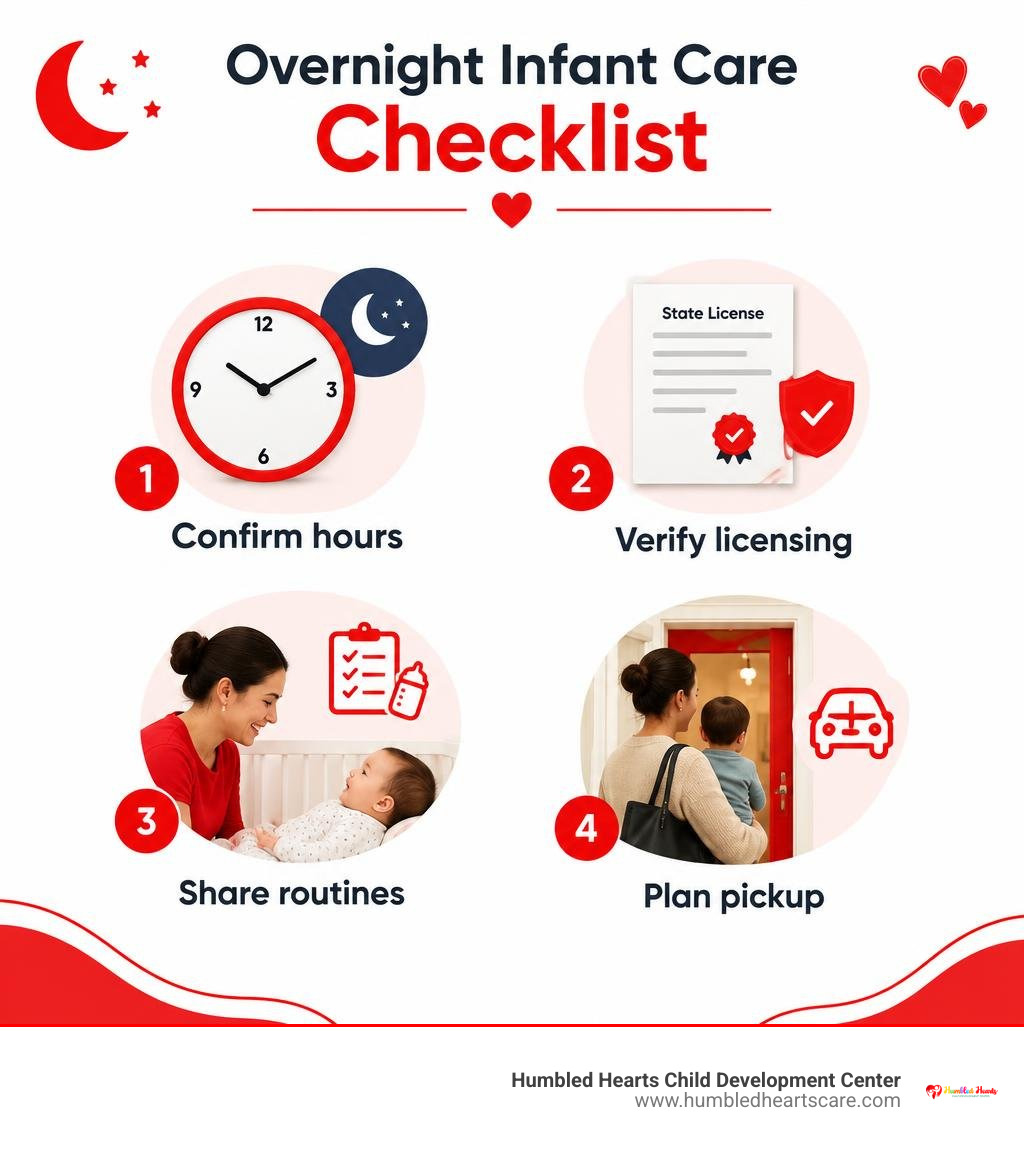
Need infant care for a night shift? Search for providers that accept your baby's age, then confirm their actual overnight hours and available spaces. Before enrolling, check their state license, ask who stays awake to supervise infants, and review their feeding, diaper, and safe-sleep routines. A center described as "24-hour" may not allow a baby to stay for 24 hours straight.
For Milwaukee families, Humbled Hearts Child Development Center is a Wisconsin DCF-licensed group childcare facility at 6003 N. Teutonia Ave, Milwaukee, WI 53209, licensed for up to 60 children. Confirm overnight availability directly with the center rather than assuming its licensed infant care includes night shifts. Tuition for ages 4 weeks-1 year is $400/week full-time or $300/week part-time; for ages 2-3 years, it is $380/week full-time or $290/week part-time.
The Parrett family founded Humbled Hearts as an in-home childcare program in 2014. Today, parents and teachers work as a team around predictable routines, personalized care, gentleness, honesty, and respect, with mild, supportive religious or moral grounding. Its mission is: "To nurture each child's unique potential through personalized care, an engaging curriculum, and a supportive environment for academic, social, emotional, and physical growth." Its vision is: "To be a leader in Early Childhood Education, ensuring that every child and family thrives through compassionate care, personalized learning, and community support-fostering a love for learning that lasts a lifetime."
Introduction
In the modern workforce, the traditional 9-to-5 workday is no longer the standard for millions of working families. Over 40% of Americans work non-typical employment shifts, including emergency healthcare professionals, first responders, manufacturing specialists, logistics workers, and service sector staff. Furthermore, with at least 46% of households in the United States operating with both parents working full-time jobs, the demand for flexible, round-the-clock childcare has become essential.
When working irregular hours, finding a secure, licensed environment for your baby can feel overwhelming. Securing dependable 24 hour daycare for infants requires understanding how nighttime supervision operates, what safety protocols must be present, and how educators maintain the warmth and consistency that tiny babies need. Let us walk you through the essential facts of overnight infant care, legal protections, and practical strategies for navigating unconventional work schedules.
Understanding 24 Hour Daycare for Infants: How Round-the-Clock Childcare Works
A 24-hour childcare facility is designed to serve working families who need care outside standard daytime hours. Rather than keeping individual children at a facility for around-the-clock days on end, these centers operate multiple overlapping shifts. They provide structured daytime early learning, transition into evening meal and winding-down routines, and offer quiet, active overnight supervision.
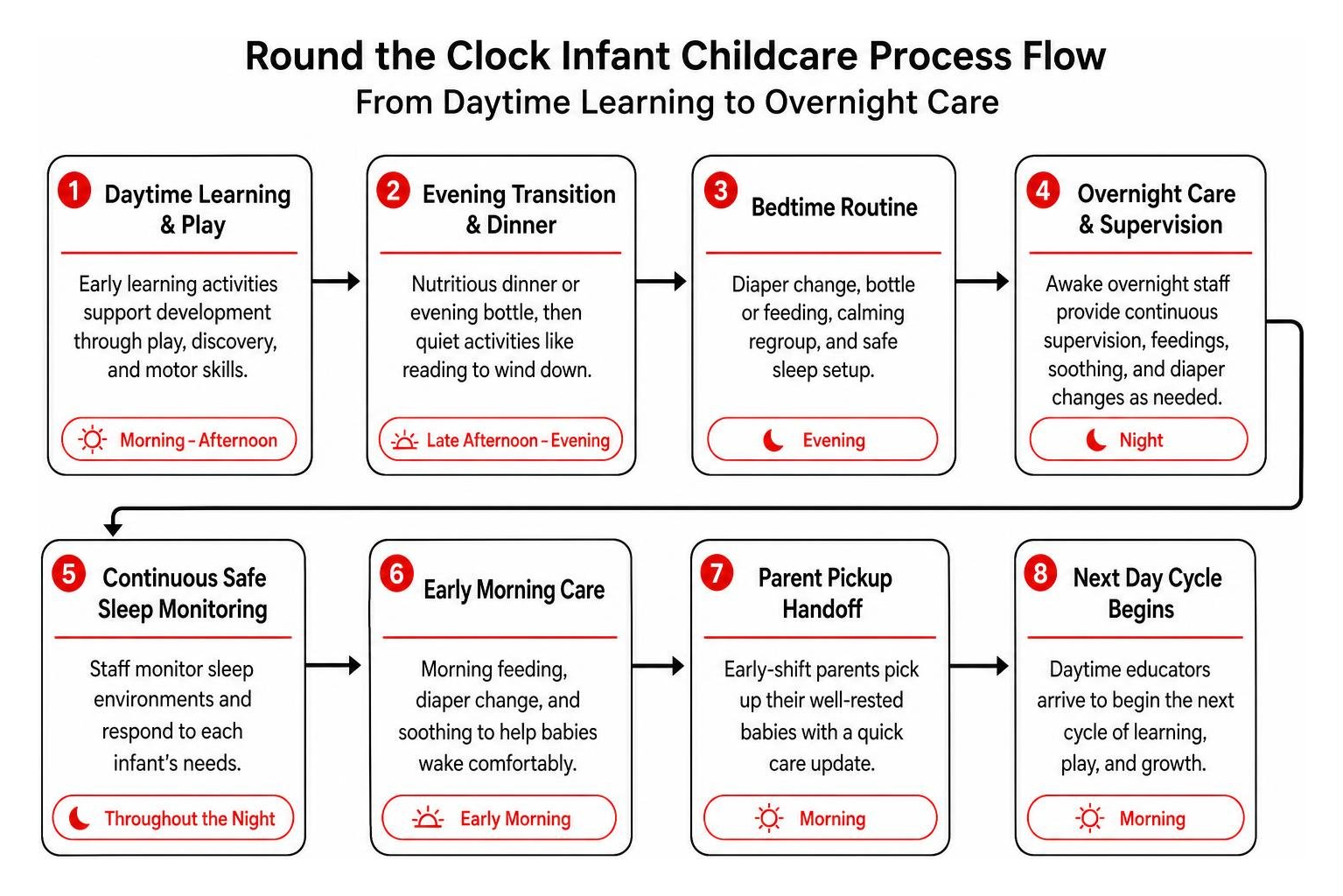
During daytime hours, these programs operate much like our comprehensive early learning programs, focusing on developmental milestones, sensory discovery, and motor skill building. As evening approaches, the energy gently shifts:
- Evening Transitions: Children eat wholesome dinners or evening bottles, engage in quiet reading, and prepare for rest.
- Nighttime Care: Dedicated overnight staff maintain continuous awake supervision, soothing infants, managing individual feeding schedules, and monitoring sleeping environments.
- Morning Handoffs: Early-shift parents pick up their well-rested babies, while daytime educators arrive to begin the next cycle of intentional play and learning.
Nighttime Routines in 24 Hour Daycare for Infants
Infants do not follow a standard adult sleep schedule. Quality round-the-clock programs prioritize individualized routines tailored to each baby's unique natural rhythms. Caregivers work collaboratively with parents to replicate home schedules as closely as possible.
- Individualized Feeding: Night-shift educators warm breast milk or formula according to your baby's specific feeding cues and schedule, logging exact ounces and times.
- Gentle Bedtime Soothing: To help babies feel secure, teachers provide gentle rocking, soft lullabies, and dim lighting during quiet periods.
- Active Overnight Monitoring: Qualified caregivers perform frequent, recorded checks on breathing, room temperature, and sleeping posture.
- Hygiene & Diapering: Diaper changes are conducted promptly using low-stimulus techniques to avoid unnecessary waking or overstimulation during late hours.
Comparing 24-Hour Daycare Scheduling Models
Understanding how different scheduling arrangements function helps parents choose the structure that best suits their family's career demands. According to the Bureau of Labor Statistics, millions of American workers hold jobs that require evening, night, or rotating shifts, making flexible childcare arrangements essential for many families.
| Feature | Fixed Overnight Schedule | Rotating-Shift Care | Drop-In / Part-Time Night Care |
|---|---|---|---|
| Best For | Set graveyard shifts (e.g., 11 PM – 7 AM) | Hospital & emergency workers with changing weekly rosters | Occasional overnight travel, backup emergencies |
| Routine Consistency | High; same crib, caregivers, and sleep times | Medium; requires active schedule syncing with staff | Variable; dependent on available space |
| Staffing Structure | Dedicated, permanent night caregivers | Flexible shift-based certified educators | On-call or reserve qualified staff |
| Billing Model | Predictable weekly or monthly tuition | Tiered hourly or shift-based rates | Per-hour or per-night fee structure |
Key Safety Standards, Licensing, and Legal Regulations
Leaving your baby in someone else’s care overnight requires absolute trust and verified safety credentials. Parents looking for overnight care should ensure providers adhere to strict quality licensed daycare standards established by state regulatory agencies.

State licensing bodies enforce rigorous rules designed to protect infants during non-traditional hours:
- Awake Supervision: Nighttime staff must remain fully awake, alert, and within immediate sight and sound of sleeping infants.
- Strict Ratios: Low caregiver-to-infant ratios (often 1:4 or 1:5, depending on state regulations) ensure prompt response to any distress.
- Pediatric Certifications: Every caregiver must hold verified certifications in infant CPR, pediatric first aid, and sudden infant death syndrome (SIDS) risk reduction.
- Background Checks: Rigorous, multi-tier background clearances—including state and federal fingerprinting—are mandatory for all on-site personnel.
- Fire Safety & Facility Approval: Centers offering overnight care must have fire marshal safety clearance, dedicated emergency evacuation plans, and dual-source emergency power.
State Regulations and Overnight Childcare Rules
Overnight infant childcare is governed by specialized regional safety guidelines. Across most jurisdictions, facilities must obtain specific license endorsements to operate after dark. In states like Arizona, licensing laws specifically prohibit a child from remaining in care for an uninterrupted 24-hour block, requiring scheduled transitions to support healthy parent-child attachment.
Furthermore, regulations require dedicated individual cribs meeting federal safety standards with firm mattresses, taut fitted sheets, sanitized personal linens for every child, and zero soft bedding or toys. Facilities offering round-the-clock schedules utilize closed-circuit security surveillance, secured keypad entry systems, and strict photo-ID check-in protocols to maintain child protection at all hours.
Costs, Subsidies, and Flexible Scheduling Options
The cost of round-the-clock infant childcare varies widely based on geographic region, facility type, and schedule regularity. Across the United States, average hourly rates for 24-hour childcare providers often hover around $22.44 per hour. However, specialized overnight blocks (such as 7:00 PM to 6:00 AM) frequently utilize discounted block rates ranging between $9 and $13 per hour, while full-day care spans from $140 to $210 depending on the provider's licensing tier.
When planning your monthly budget, comparing standard daycare prices per week for infants will help you assess full-time versus part-time options.
Childcare Assistance and Financial Support
To make flexible schedules affordable, families should explore accessible support systems:
- State Subsidies (CCAP / DES): Many licensed 24-hour programs accept state-funded childcare assistance vouchers that offset hourly or weekly tuition for qualifying families.
- Employer Dependent Care FSAs: Utilizing pre-tax Dependent Care Flexible Spending Accounts allows parents to allocate up to $5,000 annually tax-free for qualifying infant care.
- Corporate Shift-Care Stipends: Many healthcare networks and manufacturing employers offer childcare stipends or direct partnerships with regional licensed centers.
Managing Drop-In, Part-Time, and Irregular Work Shifts
Managing an irregular work schedule requires open, ongoing communication between families and caregivers. If your schedule rotates weekly:
- Provide Advanced Notice: Submit your shift schedule in writing as early as possible to secure reserved slots.
- Clarify Late-Pickup Policies: Confirm grace periods and hourly overage fees in advance so there are never surprises after an unexpected hospital shift extension.
- Maintain Digital Communication: Seek out providers that utilize real-time parent apps like Procare, allowing you to check feeding logs, sleep milestones, and diaper changes right from your phone during a work break.
How to Find, Tour, and Vet Overnight Infant Providers
Finding the right overnight caregiver requires intentional vetting. Reading verified parent feedback on reputable childcare directories is a useful starting point, but nothing replaces a thorough in-person visit.
When you are ready to evaluate prospective facilities, contact the administrative team directly to schedule a tour during operating transition hours.
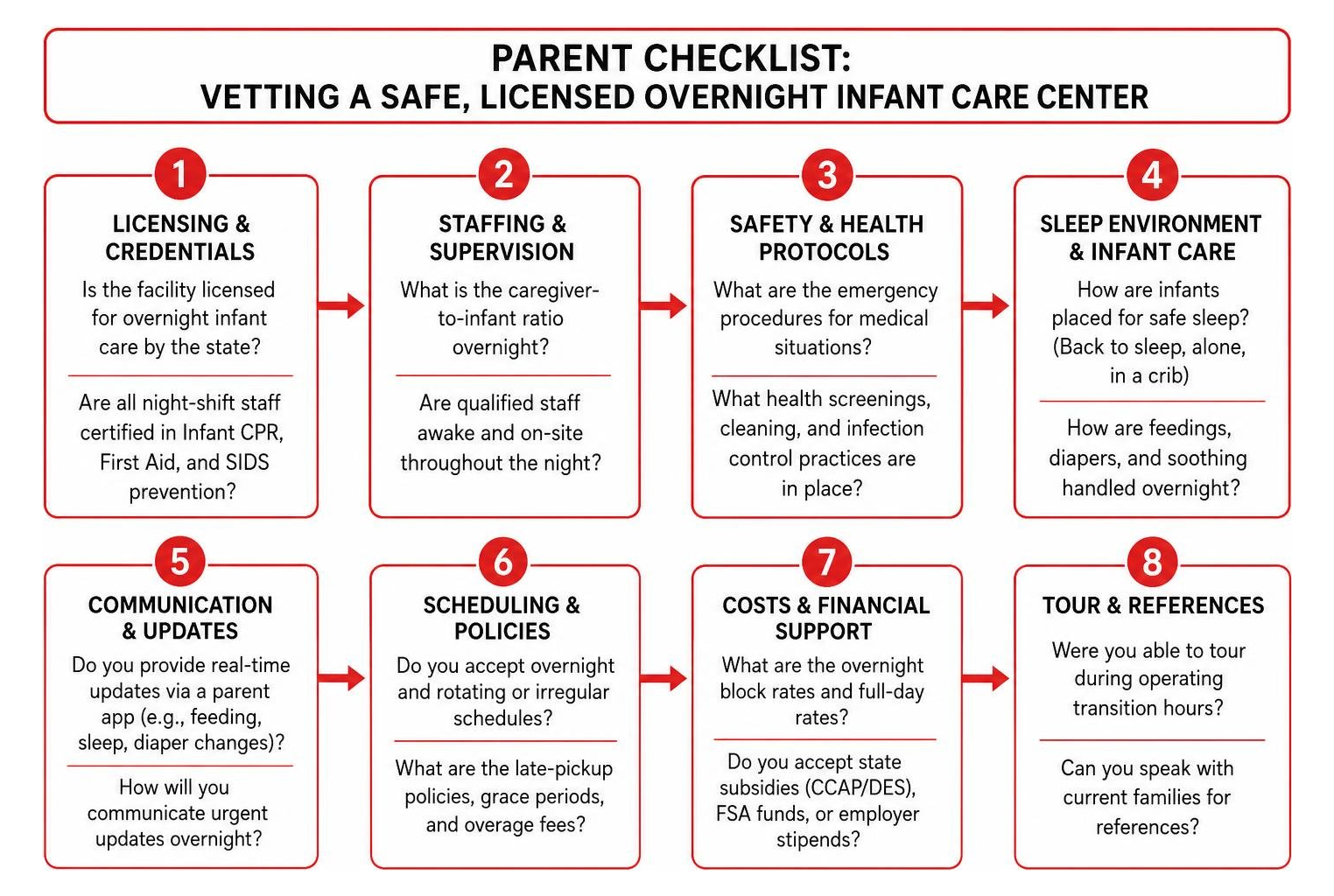
Essential Interview and Tour Questions for Parents
Take this list of questions with you when evaluating any overnight childcare provider:
- Licensing & Credentials: Is this facility fully licensed for overnight infant care by the state? Are all night-shift staff certified in Infant CPR, First Aid, and SIDS prevention?
- Nighttime Staffing: Do caregivers stay awake on active shift duty throughout the night, or is there a sleeping staff model? What is the exact staff-to-infant ratio between 8:00 PM and 6:00 AM?
- Safe Sleep Practices: Where will my baby sleep? Are cribs placed in clear view of the caregiver station? What is your procedure for checking on sleeping infants?
- Daily Communication: How do you track and share nighttime feedings, diaper changes, and sleep intervals with parents, and do caregivers and parents work together as a team on these routines?
- Security & Health: What physical security measures (cameras, locked keycard entrances) protect the building overnight? How do you handle medical emergencies or sudden illnesses after hours?
Frequently Asked Questions About Overnight Infant Care
Is overnight childcare safe for newborn babies and young infants?
Yes, overnight childcare is safe when provided by a fully licensed facility or certified caregiver adhering strictly to national safe sleep protocols. This includes placing infants on their backs to sleep on firm, flat mattresses free from loose blankets, pillows, or bumpers, with active, awake caregivers conducting continuous visual checks.
What alternatives exist if 24-hour daycare is unavailable nearby?
If a licensed 24-hour daycare center is not located in your immediate area, practical alternatives include leaning on trusted family networks, coordinating care schedules with family members, or exploring predictable, clustered shift adjustments with your employer.
Can infants stay at a childcare facility for a full 24 hours continuously?
No. State childcare licensing laws generally prohibit continuous 24-hour care for a child in a group facility. Centers enforce maximum stay limits (typically 10 to 12 hours per session) to support essential parent bonding, emotional wellness, and balanced child development.
Conclusion
Balancing a demanding career with the needs of a newborn requires reliable, compassionate support. Whether you work the night shift in healthcare, keep our communities safe as a first responder, or manage late-night operations, you deserve complete peace of mind knowing your little one is resting safely in a warm, nurturing environment.
At Humbled Hearts Child Development Center, we believe that treating every child and family like part of our own is the foundation of quality early education. Founded by the Parrett family as an in-home childcare program in 2014, our Wisconsin DCF-licensed group childcare facility at 6003 N. Teutonia Ave, Milwaukee, WI 53209 is licensed for up to 60 children. We are dedicated to whole-child growth, predictable daily routines, and gentle, loving guidance for every developmental stage.
For families seeking exceptional infant care, full-time tuition for ages 4 weeks to 1 year is $400/week ($300/week part-time), and for ages 2 to 3 years, tuition is $380/week full-time ($290/week part-time). We invite you to explore our early childhood center and schedule a tour today to meet our team and discover how we can partner together to help your child grow curious, confident, and kind.