How to Find the Best Daycare or Preschool Near You
Wondering, “What’s the best daycare or preschool near me?” Start with centers that fit your child’s age, your schedule, and your budget. Check Wisconsin licensing, tour the classrooms, ask how teachers and parents work together, and confirm current openings or waitlist steps before you apply. A high rating helps, but it cannot tell you whether a center feels right for your family.
In Milwaukee, Humbled Hearts Child Development Center is a Wisconsin DCF-licensed group childcare facility at 6003 N. Teutonia Ave. The Parrett family began it as an in-home childcare program in 2014. Today, it is licensed for up to 60 children and focuses on personalized care and whole-child growth.
Plan for cost, too: Tuition for ages 4 weeks–1 year is $400 a week full-time or $300 part-time. For ages 2–3 years, it is $380 a week full-time or $290 part-time. The steps below will help you compare care, navigate waitlists, and choose with confidence.
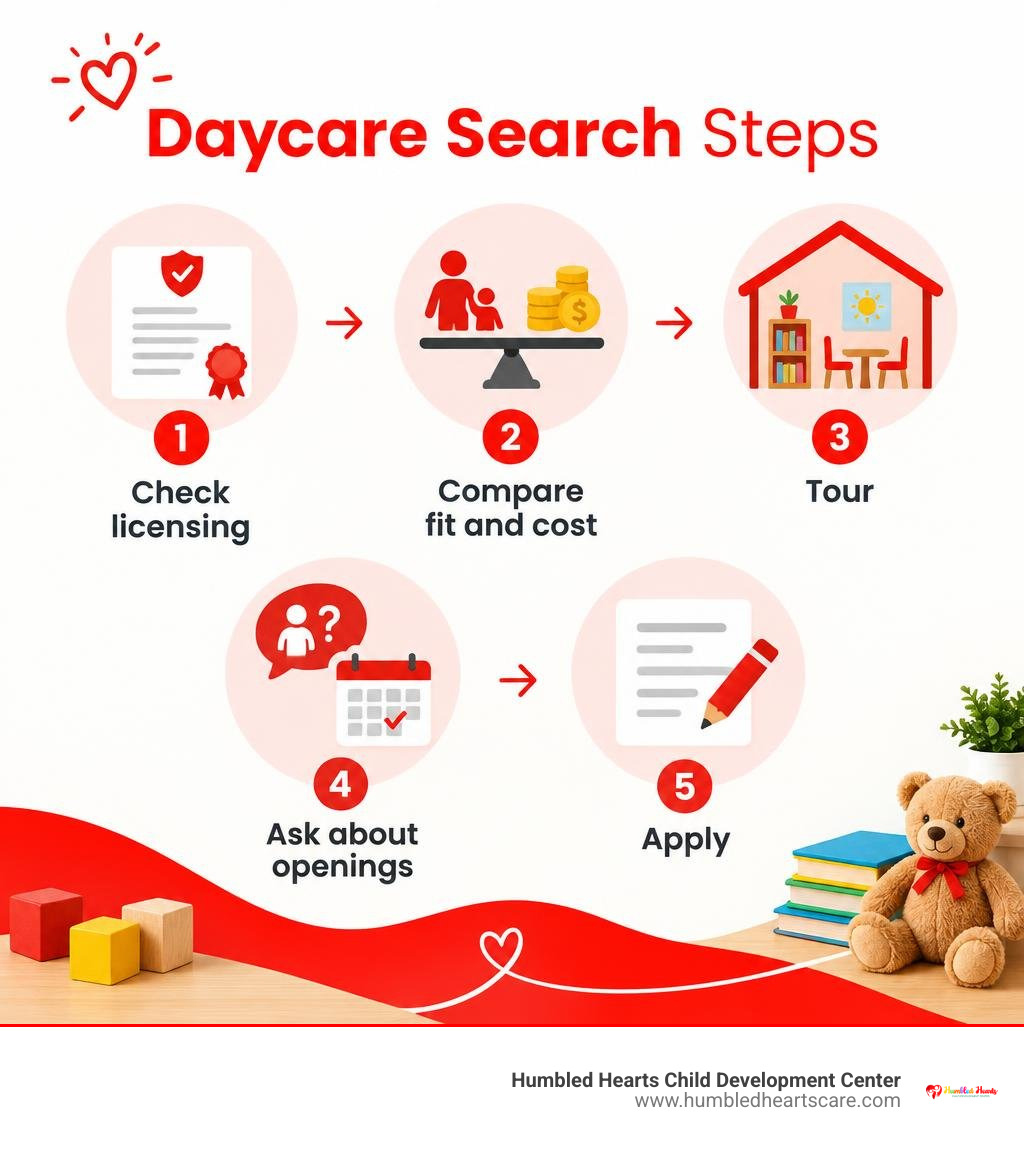
Understanding Early Childhood Options: Daycare vs. Preschool vs. Pre-K
Choosing an early learning environment can feel overwhelming when faced with industry terms like traditional daycare, developmental preschool, and Pre-K. Each serves distinct age groups, family routines, and learning objectives. Understanding these distinctions ensures you select an environment that aligns with your family's schedule and your child's developmental stage.
At their core, our early childhood education programs provide supportive settings that nurture academic curiosity and social development alongside reliable care for working families.
| Program Type | Typical Age Range | Schedule Flexibility | Primary Focus | Potty-Training Required? |
|---|---|---|---|---|
| Daycare / Infant Care | 6 weeks (or 4 weeks) to 2 years | Year-round, full-day (often 10–12 hours daily) | Sensory discovery, basic motor skills, nurturing attachment, and routines | No |
| Preschool | 2 to 4 years | Full-day, half-day, or part-time options | Social-emotional growth, intentional play, early language, and peer collaboration | Often required, though flexible centers assist |
| Pre-Kindergarten (Pre-K) | 4 to 5 years | Full school days or extended care | Kindergarten readiness, foundational literacy, math concepts, self-regulation | Yes |
Key Differences in Curriculum, Schedules, and Age Requirements
Daycares primarily focus on meeting physical and emotional milestones throughout extended working hours. Infants and young toddlers receive personalized care that emphasizes motor coordination, secure attachment, and predictable daily routines.
Preschools introduce structured routines designed around foundational social development and intentional play. While regional hubs like the Plano preschool community often feature programs requiring children to be fully potty-trained before admission, many holistic centers work closely with parents to support toilet training transitions.
Pre-K programs concentrate on kindergarten readiness, helping children master self-help skills, cooperative play, early literacy, and basic STEM enrichment so they transition into elementary school with confidence.
How to Evaluate and Find the Best Daycare Preschool Near Me
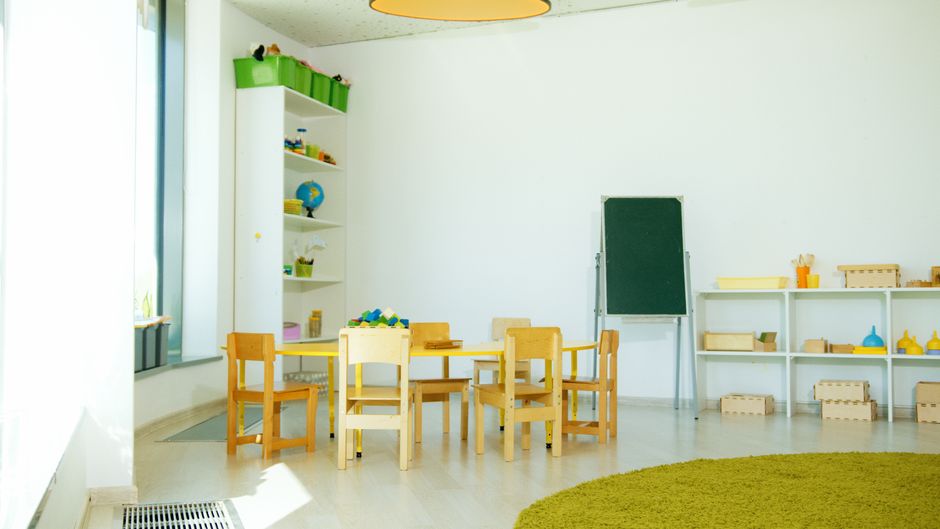
Finding a safe, nurturing environment requires looking beyond online star ratings. While directory platforms aggregate parent reviews—where platforms like Winnie report average ratings near 5.0 stars across thousands of listings—discovering the best daycare preschool near me requires verifying safety metrics and state compliance firsthand.
Begin by researching regulatory standing. A state-licensed center must comply with strict safety rules, caregiver background checks, and maximum adult-to-child ratios. Families seeking licensed early childhood care can consult official registries to confirm a facility's credentials.
For broader regional context on what makes an early education environment thrive, reading a regional early education guide provides perspective on classroom ratios, campus amenities, and family involvement models.
Essential Checklist for Touring the Best Daycare Preschool Near Me
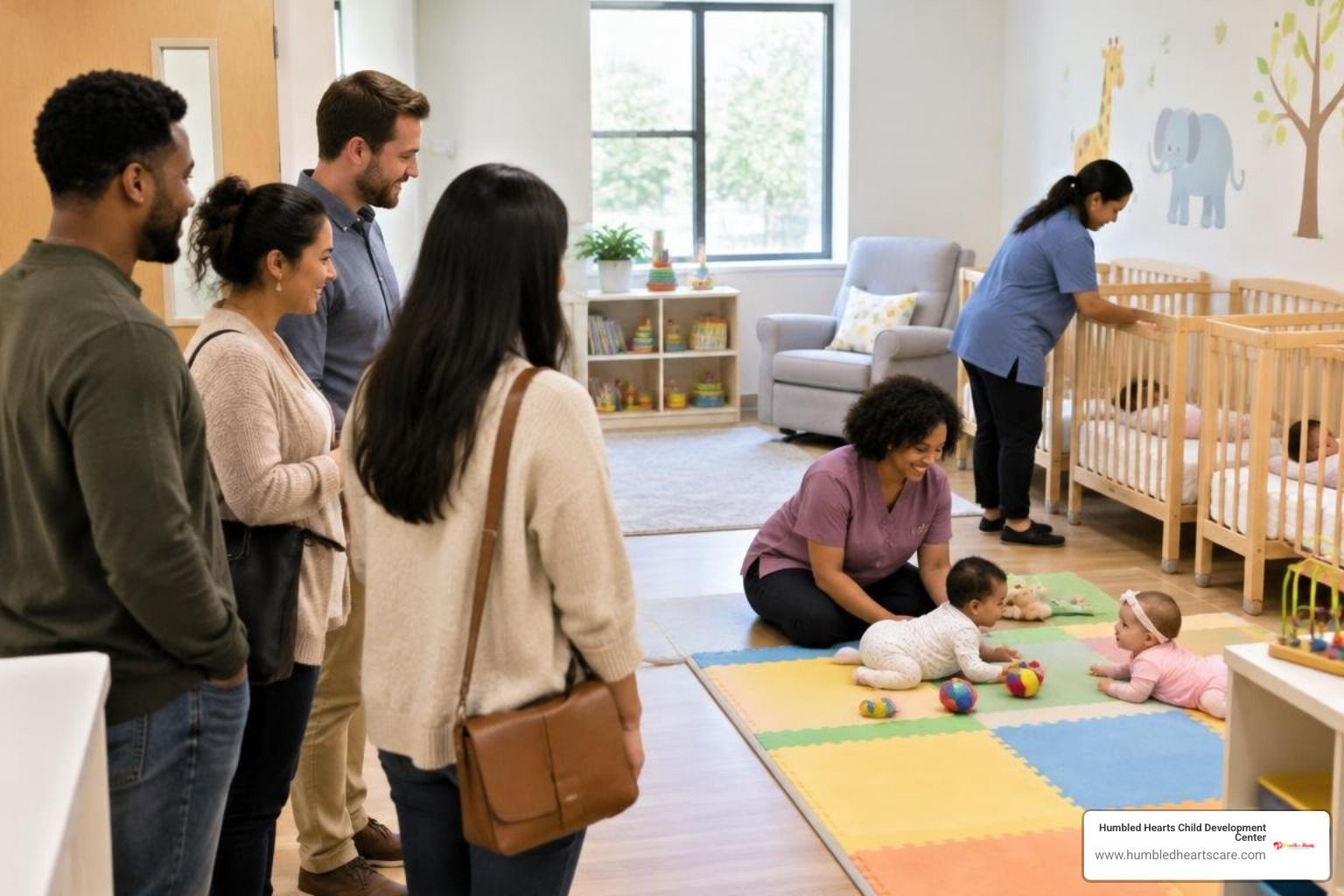
When touring facilities, observe how staff interact with the children. A positive setting is filled with warm, engaged conversations at eye level rather than passive supervision.
Here is what to look for during your visit to a structured daycare center:
- Classroom Engagement & Tone: Are teachers speaking gently with children? Do children appear relaxed, curious, and actively engaged with learning materials?
- Health & Cleanliness: Are diaper-changing and meal-preparation stations clean and separated? Look for helpful safety measures such as shoe-free infant rooms that keep floor play clean for crawling babies.
- Safety & Ratios: Are the teacher-to-child ratios strictly maintained? For infants, ratios should never exceed 1:4.
- Transparent Communication: Does the facility offer seamless communication via Procare or similar real-time platforms for photos, daily logs, and milestone alerts?
- Outdoor & Gross Motor Spaces: Is there a secure outdoor play area designed for daily fresh air and physical development?
Comparing Educational Philosophies to Choose the Best Daycare Preschool Near Me
Different programs utilize varied educational frameworks. Choosing the right philosophy depends on your child's personality and your family's core values.
- Play-Based Learning: Grounded in child-directed play, this approach uses intentional play to develop problem-solving, creativity, and conflict-resolution skills.
- Montessori: Features self-directed activity, hands-on learning with specialized wooden materials, and mixed-age classrooms that foster independent thinking.
- Bilingual & Language Immersion: Incorporates a second language (such as Spanish, French, or Mandarin) throughout daily instruction. Exploring bilingual early childhood programs shows that early language exposure boosts cognitive flexibility and cultural awareness.
- Whole-Child & Values-Based Care: Combines structured academic readiness with character growth, gentleness, honesty, and respect. Our preschool curriculum emphasizes this balanced approach, supporting every child's academic, social, emotional, and physical milestones.
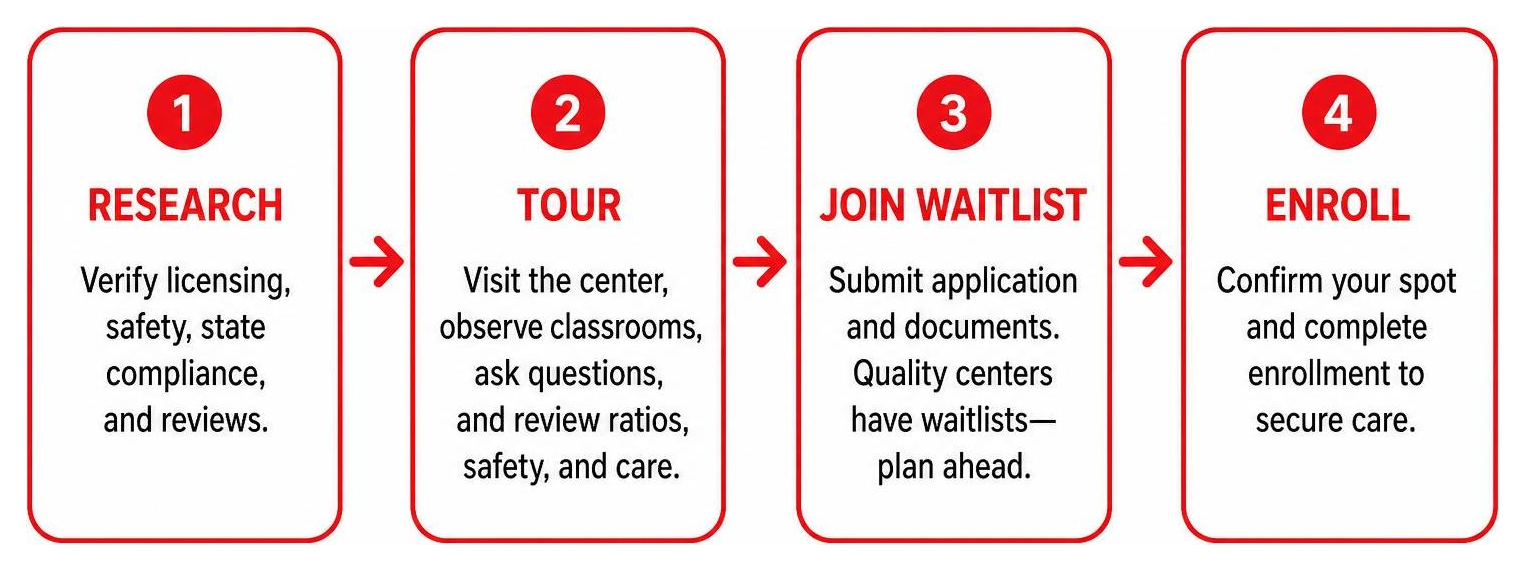
Navigating Childcare Waitlists, Availability, and Admissions
Securing a spot in a reputable childcare facility requires advance planning. Because quality providers maintain low child-to-teacher ratios, infant and toddler rooms often reach maximum capacity months ahead of time.
To navigate admissions smoothly:
- Start Early: If you are expecting, begin touring and applying during your second trimester. Infant openings are often reserved 6 to 12 months in advance.
- Apply to Multiple Quality Programs: Submit applications to two or three licensed centers to give your family viable options.
- Follow Up Consistently: Contact admissions coordinators every 4 to 6 weeks to reaffirm your interest and provide any updated start dates.
- Understand Fees & Deposits: Confirm whether waitlist fees are non-refundable and ask how deposits apply toward your child's first tuition invoice.
Families looking for a clear and welcoming pathway can review our childcare admissions process to understand registration steps, enrollment documents, and classroom orientations.
Understanding Tuition Costs, Subsidies, and Value
Childcare costs vary based on your location, program offerings, and your child's age group. Because infants require lower staff ratios, infant care represents the highest investment.
When calculating the true value of tuition, consider the comprehensive benefits included in the program:
- Nutritious Meals: Centers that provide fresh daily meals and snacks save parents several hours of preparation each week.
- Transportation Services: Convenient local transportation eliminates stressful morning and evening commute hurdles.
- Enrichment Activities: Look for programs offering regular field trips, birthday celebrations, holiday events, and specialized STEM activities without hidden add-on fees.
- Childcare Subsidies: Many families qualify for state-funded childcare assistance (such as Wisconsin Shares), which offsets monthly tuition costs at licensed centers.
Frequently Asked Questions About Daycare and Preschool Selection
What age should my child start daycare or preschool?
Children can begin center-based care in early infancy; some programs welcome babies starting at 4 to 6 weeks of age. Starting early helps infants adapt easily to group routines, while entering care between ages 2 and 3 provides toddlers with structured opportunities to develop peer socialization, speech, and emotional regulation.
How do I verify a childcare center's licensing and violation record?
Every state maintains a searchable public licensing database overseen by departments like the Department of Children and Families (DCF). You can look up any licensed facility to review its capacity limits, staff background check compliance, past inspections, and any documented health or safety violations.
How far in advance should I join a daycare waitlist?
For infant care, joining a waitlist 6 to 12 months ahead of your anticipated return to work is recommended. For preschool and Pre-K programs, starting your search 3 to 6 months before the upcoming fall or summer term typically provides ample time to tour, register, and prepare your child for their transition.
Conclusion

Choosing the best daycare or preschool for your family comes down to finding an environment where your child feels safe, valued, and encouraged to grow curious, confident, and kind. At Humbled Hearts Child Development Center, we believe that parents and teachers form an essential collaborative team, treating every child and family like part of our own.
The Parrett family founded Humbled Hearts as an in-home childcare program in 2014. Today, we operate as a Wisconsin DCF-licensed group childcare facility for up to 60 children, located at 6003 N. Teutonia Ave, Milwaukee, WI 53209.
Our mission is: “To nurture each child’s unique potential through personalized care, an engaging curriculum, and a supportive environment for academic, social, emotional, and physical growth.”
Guided by our vision: “To be a leader in Early Childhood Education, ensuring that every child and family thrives through compassionate care, personalized learning, and community support—fostering a love for learning that lasts a lifetime,” we provide:
- High-quality, personalized care for infants through school-age children.
- Clear tuition rates: $400/week full-time ($300/week part-time) for ages 4 weeks–1 year, and $380/week full-time ($290/week part-time) for ages 2–3 years.
- Fresh daily meals and nutritious snacks prepared on site.
- Free local transportation within our designated service radius.
- Predictable daily routines with gentle moral grounding, respect, and honesty.
- Inclusive support for children with exceptional or special needs.
- Year-round field trips, including weekly summer field trips, birthday celebrations, and themed enrichment.
- Real-time updates and peace of mind through Procare.
We invite your family to visit our classrooms, meet our caring educators, and experience our community firsthand. Learn more about our programs and schedule a tour or call us at 414-539-6513 to take the next step in your child's early education journey.